


Page 56 - A&A Patents&Design Rewind-2016
P. 56
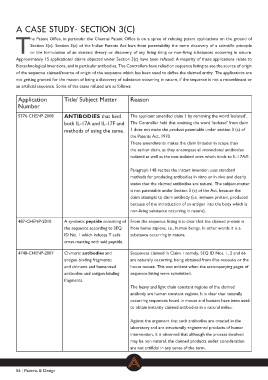
A CASE STUDY- SECTION 3(C)he Patent Office, in particular the Chennai Patent Office is on a spree of refusing patent applications on the ground of

         Section 3(c). Section 3(c) of the Indian Patents Act bars from patentability the mere discovery of a scientific principle

Tor the formulation of an abstract theory or discovery of any living thing or non-living substances occurring in nature.

Approximately 15 applications/ claims objected under Section 3(c) have been refused. A majority of these applications relate to
Biotechnological inventions, and in particular antibodies. The Controllers have relied on sequence listing to see the source of origin
of the sequence claimed/source of origin of the sequence which has been used to define the claimed entity. The applications are
not getting granted for the reason of being a discovery of substance occurring in nature, if the sequence is not a recombinant or
an artificial sequence. Some of the cases refused are as follows:

Application            Title/ Subject Matter Reason
Number
                       ANTIBODIES that bind               The applicant amended claim 1 by removing the word ‘isolated’.
5376-CHENP-2008        both IL-17A and IL-17F and         The Controller held that omitting the word ‘isolated’ from claim
                                                          1 does not make the product patentable under section 3 (c) of
                       methods of using the same.         the Patents Act, 1970.
                                                          These amendments makes the claim broader in scope than
                                                          the earlier claim, as they encompass all monoclonal antibodies
                                                          isolated as well as the non-isolated ones which binds to IL-17A/F.

                                                          Paragraph 148 recites the instant invention uses standard
                                                          methods for producing antibodies in vitro or in vivo and clearly
                                                          states that the claimed antibodies are natural. The subject-matter
                                                          is not patentable under Section 3 (c) of the Act, because the
                                                          claim attempts to claim antibody (i.e. immune protein, produced
                                                          because of the introduction of an antigen into the body which is
                                                          non-living substance occurring in nature).

487-CHENP-2010         A synthetic peptide consisting of  From the sequence listing it is clear that the claimed protein is
4748-CHENP-2007        the sequence according to SEQ      from homo sapiens, i.e., human beings. In other words it is a
                       ID No. 1 which induces T cells     substance occurring in nature.
                       cross-reacting with said peptide.

                       Chimeric antibodies and            Sequences claimed in Claim 1 namely, SEQ ID Nos. 1, 2 and 66
                       antigen-binding fragments;         are naturally occurring, being obtained from Mus musculus or the
                       and chimeric and humanized         house mouse. This was evident when the accompanying pages of
                       antibodies and antigen-binding     sequence listing were scrutinized.
                       fragments.
                                                          The heavy and light chain constant regions of the claimed
                                                          antibody are human constant regions. It is clear that naturally
                                                          occurring sequences found in mouse and humans have been used
                                                          to obtain instantly claimed antibodies in a natural milieu.

                                                          Against the argument that such antibodies are created in the
                                                          laboratory and are structurally engineered products of human
                                                          intervention, it is observed that although the process involved
                                                          may be non-natural, the claimed products under consideration
                                                          are not artificial in any sense of the term.

56 | Patents & Design

